
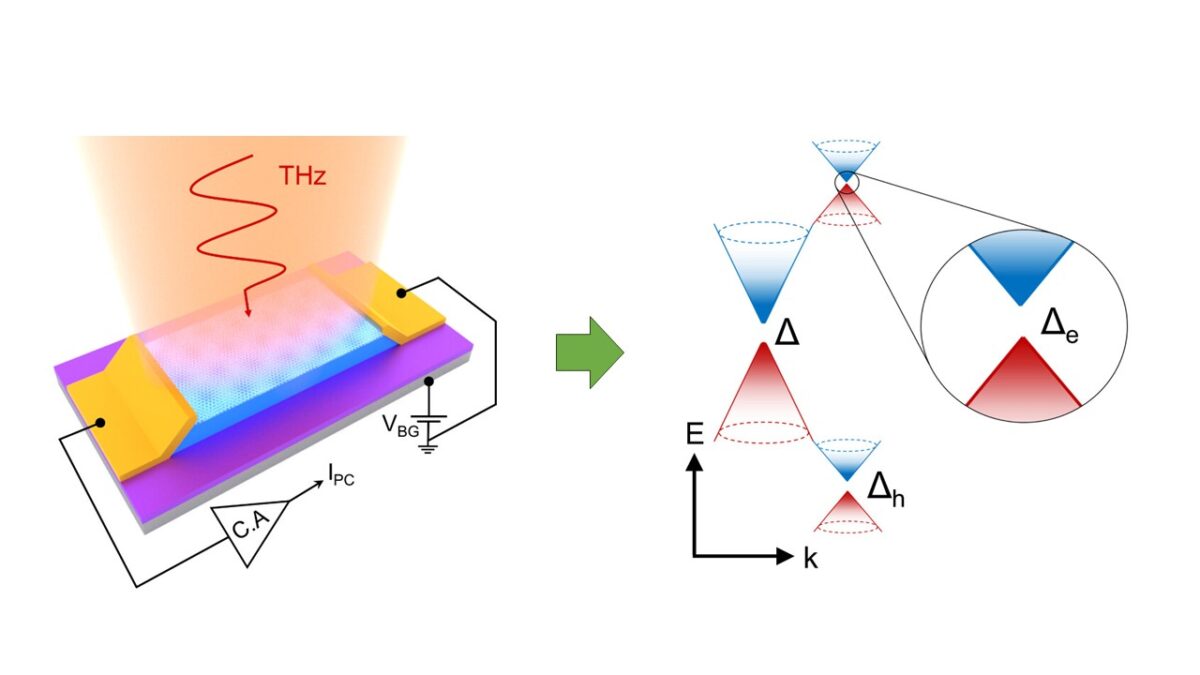
We present gate-dependent terahertz photocurrent spectroscopy as a robust technique to detect, explore, and quantify intricate electronic properties in graphene moiré superlattices. Specifically, using terahertz light at different frequencies, we demonstrate distinct photocurrent regimes, evidencing the presence of avoided band crossings and tiny (∼1 to 20 meV) inversion-breaking global and local energy gaps in the miniband structure of minimally twisted graphene and hexagonal boron nitride heterostructures, key information that is inaccessible by conventional electrical or optical techniques. In the off-resonance regime, when the radiation energy is smaller than the gap values, enhanced zero-bias responsivities arise in the system due to the lower Fermi velocities and specific valley degeneracies of the charge carriers subjected to moiré superlattice potentials. In stark contrast, the above-gap excitations give rise to bulk photocurrents─intriguing optoelectronic responses related to the geometric Berry phase of the constituting electronic minibands. Besides their fundamental importance, these results place moiré superlattices as promising material platforms for advanced, sensitive, and low-noise terahertz detection applications.
Link to the article
The study was widely difused in several media, see the following press releases (in spanish):